
Shape
See also
This is the generation-time override. To author a shape layer's full schema at import time, see Design Import → Layer Types → Shape.
The shape type (rectangle, circle, triangle, blob, cross, half_circle, cloud, pentagon, right_triangle, star_1, star_2, arrow, heart, hexagon, trapeze, hexagram, rhombus, parallelogram, squircle) can only be selected in the design builder.
Available properties
| Property | Description |
|---|---|
background_color | Monochrome (6–8 digit hex), linear or radial gradient, or cmyka (print). Accepts a gradient. Full token grammar: Colors & Gradients below. |
pattern_name / pattern_color | See Pattern |
stroke_width / stroke_color | Shape outline. stroke_width is 0–60 on shapes (text allows 0–40); same value semantics as Stroke otherwise |
shadow_color / shadow_blur / shadow_offset_x / shadow_offset_y | See Shadow |
Pattern
pattern_name: The pattern type to applypattern_color: 6–8 digit hex color
Available pattern names: bubbles, cage, cross, doubleCircle, drops, parkay, pills, plus, star, ticTac, ticTacFilled, triangle, wiggle
| Pattern | Preview | Pattern | Preview | Pattern | Preview |
|---|---|---|---|---|---|
bubbles | 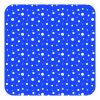 | cage |  | cross |  |
doubleCircle |  | drops |  | parkay | 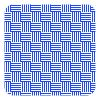 |
pills | 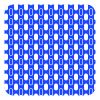 | plus |  | star |  |
ticTac | 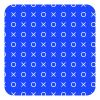 | ticTacFilled | 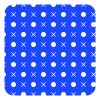 | triangle |  |
wiggle | 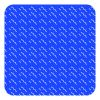 |
Example
{
  "background_color": "#1A47FF",
  "pattern_name": "ticTacFilled",
  "pattern_color": "#FFFFFF1A"
}
Colors & Gradients
Full color and gradient token grammar
Every color field across the API takes a string token. Which token forms are accepted depends on the design type and on the specific field. The grammar is the same when you import a design and when you override a color at generation time.
Hex
#RRGGBB or #RRGGBBAA, or the CSS shorthand #RGB / #RGBA. The 8- and 4-digit forms carry alpha. Case-insensitive.
| Value | Result |
|---|---|
#ffffff, #FFFFFF, #ffffff80 | ✅ Accepted |
#fff, #fffa | ✅ Accepted. An import stores the full form (#ffffff, #ffffffaa). |
ff0000 (no #) | ❌ Rejected |
#fffff, #fffffff (5 or 7 digits) | ❌ Rejected |
rgb(255,0,0), red | ❌ Rejected |
Linear gradient
Linear gradients use Abyssale's own grammar, not CSS. CSS gradient syntax will not match:
linear-gradient(<x>% <y>% <x1>% <y1>%,<offset>% <color> <opacity>,<offset>% <color> <opacity>[,…])- The line comes first: start point
<x>% <y>%, then end point<x1>% <y1>%, all four space-separated. - Then 2 to 8 stops, comma-separated, with no space after a comma. Each stop is
<offset>% <color> <opacity>, separated by single spaces. offsetis0%to100%. Each stop carries its own offset, so stops need not be evenly spaced. Order them by ascending offset.coloris#RRGGBBor#RGB, orcmyk(C,M,Y,K)written without spaces. Every stop uses the same notation: a hex stop next to a CMYK stop is rejected.opacityis a bare number from0to1(1,0.5), not a percentage. It is the only transparency a stop has, so a stop color with alpha (#RRGGBBAA,#RGBA,cmyka(...)) is rejected.
| Stop | Result |
|---|---|
0% #FF0000 1, 50% #f00 0.5, 100% cmyk(0,100,100,0) 1 | ✅ Accepted |
101% #FF0000 1 | ❌ Offset above 100% |
0% #FF0000 2 | ❌ Opacity above 1 |
0% #FF000080 1, 0% #F00F 1 | ❌ Alpha in the stop color: use the opacity |
0% cmyk(0, 100, 100, 0) 1 | ❌ Spaces inside a CMYK stop |
A worked example — an opaque top-to-bottom teal → navy fill:
"background_color": "linear-gradient(0% 0% 0% 100%,0% #0a363a 1,100% #041b2d 1)"And the same line with a highlight three quarters of the way down:
"background_color": "linear-gradient(0% 0% 0% 100%,0% #0a363a 1,75% #1d6f78 1,100% #041b2d 1)"Radial gradient
Same grammar family: the stops are exactly the linear ones, only the head differs.
radial-gradient(<cx>% <cy>% <r>%,<offset>% <color> <opacity>,<offset>% <color> <opacity>[,…])- The head is the centre
<cx>% <cy>%then the radius<r>%, space-separated integers. - Percentages are of the layer's own box.
cx/cyare measured from its top-left corner, and the radius isr%of the width horizontally andr%of the height vertically — so on a non-square layer the gradient is an ellipse fitted to the box, the same shape the editor draws.50% 50% 50%touches the four edges;50% 50% 71%reaches the corners. offsetruns from the centre (0%) to the edge of that ellipse (100%). Past the last stop the last colour continues to the edge of the layer.- The radius must be above
0%. There is no focal point. - Then 2 to 8 stops, with every stop rule of the linear gradient above.
| Head | Result |
|---|---|
50% 50% 71%, 30% 40% 60%, 150% 120% 200% | ✅ Accepted |
50% 50% 0% | ❌ Radius 0 |
50% 50%, 50% 50% 71% 30% 30% | ❌ 2 or 5 values: the head is exactly centre + radius |
circle at center, ellipse 50% 50% at 50% 50% | ❌ CSS syntax |
A spotlight off to the upper left:
"background_color": "radial-gradient(30% 40% 60%,0% #ffd166 1,35% #ff5d5d 1,100% #1a47ff 1)"Only fill-type fields accept a gradient, and a field that takes one takes both kinds, linear and radial. The property table you came from says whether a specific field is one of them.
| Accepts a gradient | Hex / CMYK only |
|---|---|
A format background on static / animated | A page background, and a format background on printer |
A shape or button layer's background_color | A text layer's background_color, and both colours of a rating |
A shape or button background_color on printer (CMYK stops) | A page background, and text on printer |
color on a text or button layer, on static / animated | Borders and strokes |
| Shadows and text decoration | |
| Overlays and patterns |
CMYK
cmyk(C,M,Y,K) cmyka(C,M,Y,K) cmyka(C,M,Y,K,A)- Each component is an integer from 0 to 100, alpha included. A
%after a component is accepted (cmyk(0%,100%,90%,10%)), and so are leading zeros (cmyk(007,0,0,0)). - Spaces around the components are accepted (
cmyk( 0, 100, 90, 10 )), except in a gradient stop, which is writtencmyk(C,M,Y,K)with no spaces. - Case-insensitive, and a 5-component
cmyk(...)is read ascmyka(...). - An import stores the canonical spelling:
cmyk(0%, 100%, 90%, 10%)is stored ascmyk(0,100,90,10), andcmyka(C,M,Y,K,100)ascmyk(C,M,Y,K).
Print designs (printer / printer_multipage) store CMYK. On static / animated a CMYK color is converted to hex. See Print Imports → Colors.
Which token on which design type
| Token | static / animated | printer / printer_multipage |
|---|---|---|
#RRGGBB / #RRGGBBAA | ✅ Accepted | ✅ Converted to cmyk(...) + color_converted warning |
linear-gradient(...) / radial-gradient(...) | ✅ On gradient-capable fields, with hex stops (cmyk(...) stops are unsupported_for_type at import) | ✅ On shape and button background_color — hex stops converted per stop + color_converted warning |
cmyk(...) / cmyka(...) | ✅ Converted to hex + color_converted warning | ✅ Stored, in the canonical spelling |
A solid color in the "wrong" space is converted, not rejected. The warning names the path and both values; alpha survives in both directions (#RRGGBBAA ⇄ cmyka(C,M,Y,K,A)), and the hex the converter emits is uppercase.
Conversion is approximate
No ICC profile is involved, so a converted print color is a close approximation, not a colour-managed match. Author cmyk(...) yourself when the exact ink matters — it is then stored verbatim, with no conversion and no warning.
Why a gradient converts stop by stop
A gradient used to be refused on print outright, because converting one meant collapsing it to its first colour — silently turning your artwork into a flat fill. The pipeline now carries every stop through to a shading in the PDF (axial for linear, radial for radial), so a gradient converts the way a solid colour does: each stop individually, at the same approximate accuracy, with the warning telling you it happened.
What still cannot convert is alpha. A PDF shading has no alpha channel, so a semi-transparent stop has nowhere to go; flattening it onto white would ship a colour you never authored, so it is refused instead.
A malformed token is invalid_payload, both at import and at generation, and the error message spells out the accepted forms. Malformed means: a CMYK component above 100, a gradient with fewer than 2 or more than 8 stops, a radial radius of 0%, a stop offset above 100%, a stop opacity above 1, or a stop color with alpha.
Gradients on print designs
printer / printer_multipage designs accept a linear or radial gradient on a shape or button background_color, with the same grammar and the same 2-to-8 stop range. Two rules differ:
- Stops are stored as
cmyk(...). You may author them in hex: each stop is converted individually, with acolor_convertedwarning naming the path — the same rule a solid colour follows. Authorcmyk(...)yourself when the exact ink matters, and it is stored verbatim. - Stops must be opaque. A PDF shading carries no alpha, so a semi-transparent stop is rejected rather than silently flattened. Send
1as the alpha of every stop.
"background_color": "linear-gradient(0% 0% 0% 100%,0% cmyk(0,100,100,0) 1,50% cmyk(0,0,100,0) 1,100% cmyk(100,0,0,0) 1)"Printer color defaults
On printer, defaults are CMYK too: text / shape / button / qrcode colors default to cmyk(0,0,0,100) (black) and button text to cmyk(0,0,0,0) (white). Rating layers get print-appropriate defaults from the backend — star_color → cmyk(0,20,65,0) and background_color → cmyk(0,0,0,8) — where static/animated keep #FFCD59 / #EAEAEA.
Related
- Image — masks and filters live there, not on shapes
- Common properties —
hiddenand shadows